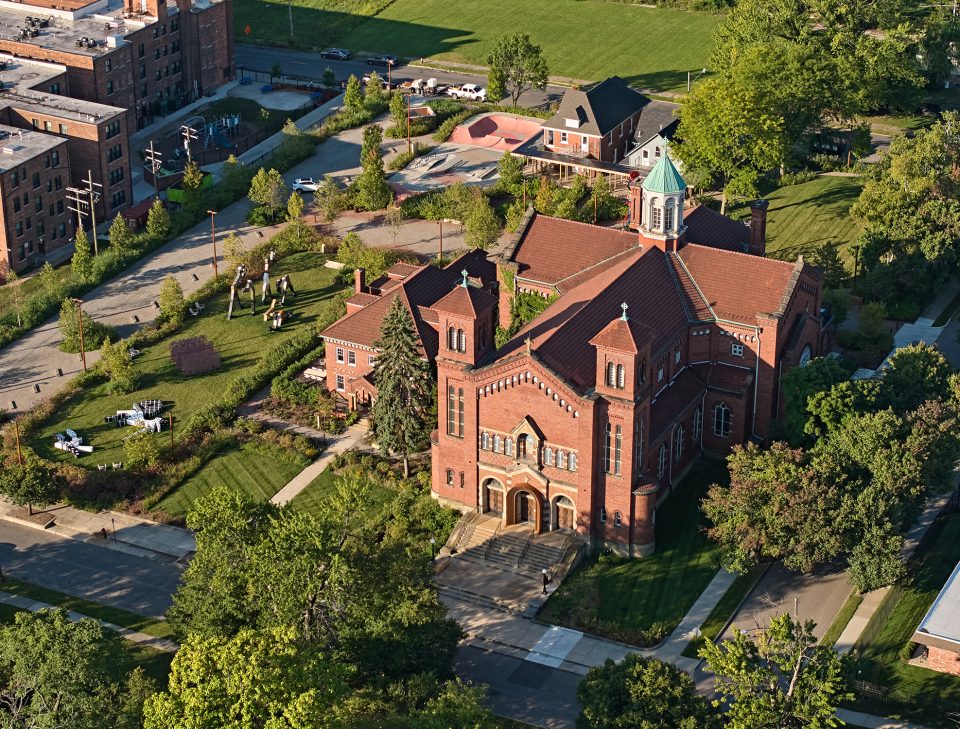
Between Your Love and Mine
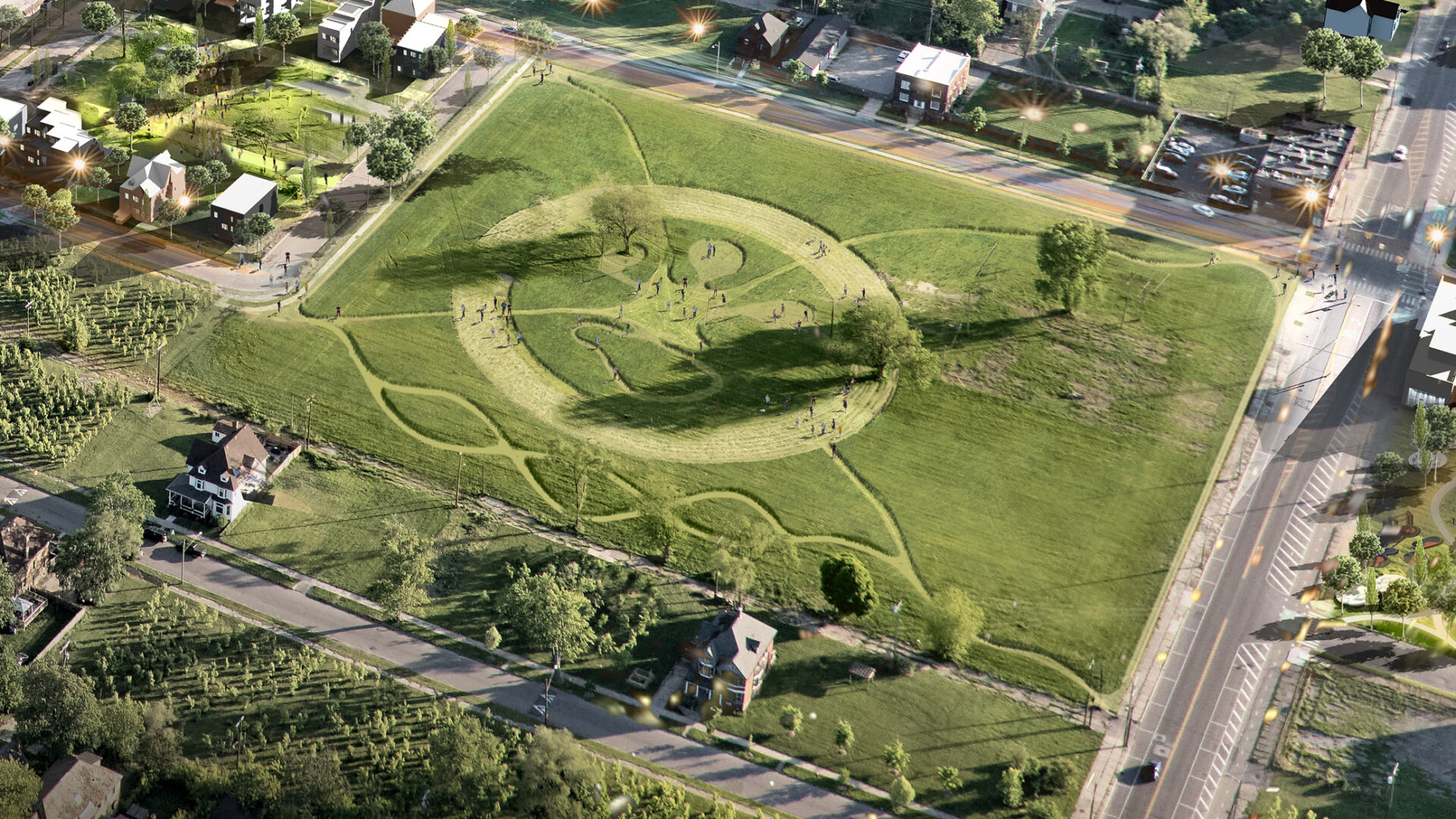
“Between Your Love & Mine” is a 250-foot-diameter circular park where installations explore borders, kinship, and community.
“Between Your Love & Mine” is a 250-foot-diameter circular park where installations explore borders, kinship, and community.
Look south, and you can almost see Canada. Past Belle Isle, the border is less than two miles away—an invisible line bisecting the Detroit River. On the far shore is Windsor. Viewed from an airplane, or even certain street corners, two cities appear as one. In some ways, they are. Before a colonial border was drawn, the Anishnabeg of the Three Fires Confederacy stewarded these lands. After the Revolutionary War and the Jay Treaty, both shores shared entwined histories, from the Underground Railroad to an integrated industrial economy.
For thousands of nurses, students, and auto workers, daily commutes traverse an international boundary. Family, friendship, and culture all transcend divisions of nation through the more fundamental stuff of love and community. Some recall a pre-9/11 border that hardly existed, with passage punctuated by a friendly wave. For many, every crossing carries the spectre of detention and deportation—risks disproportionately borne by immigrants and communities of color. Today, border militarization is paired with political and economic tensions, manifested in tariffs and threats of annexation.
It reveals an uncomfortable truth; the border is always being imagined and negotiated. Here, the line is interpreted as a circle. On this ground, designers from both countries mine the cultural heritage of the spaces in between. Of communities united by kinship, and enriched by their differences. — Stefan Novakovic
MEADOW
Designed by OSD (Office for Strategy + Design)
The flag, a foundational symbol of statehood, serves myriad other purposes. Here, an evocation of the nation is paired with humble marker flags, used to denote utilities like sewers, electric cables and water pipes, as well as property boundaries. Laid out in partnership with artists from PASC, these lines of property, infrastructure and nation are transformed into a floral meadow.
GRID
Designed by Studio of Contemporary Architecture (SOCA)
A grid of 36 stakes rises from the ground. Often used to anchor fences, these heavy-duty 6 x 6 wood posts are a ubiquitous element of North American life, demarcating property and territory. Instead of a line, they are arranged in a grid, creating a space shaped by a sense of transition. Instead of a discrete threshold, the boundary is stretched into three dimensions.
SWING
Designed by Brian Richer / Castor Design
Border crossings are spaces of order, surveillance and discipline. From lanes of cars and trucks to fences and checkpoints, movement is controlled and restricted. The act of play — swinging from a tire in a tree — can be a kind of spatial rebellion. Sourced at Mack Avenue’s Hood’s Tire Services, the tire in the center is a little piece of Motor City.
PORCH
Designed by UNDECORATED
Two wooden skids make a stage. Recycled from a nearby lumber yard, these oversized industrial skids are paired to create a bifocal gathering space. During large events, speakers address an audience assembled along the circle perimeter. For more intimate gatherings, the stage faces into the smaller clearing inside.
CIRCLE
Designed by OSD (Office for Strategy + Design)
Along much of the 49th parallel, the Canada–United States border is expressed as “The Slash,” a 20’ clearing of coniferous forest that divides two nations. Here, the line becomes a circle. It functions as both threshold and sanctuary — a border to cross and a destination for community. In a city built by waves of arrival, this act of crossing invites questions about who gets to be here and on what terms.